






A flower conquers the world

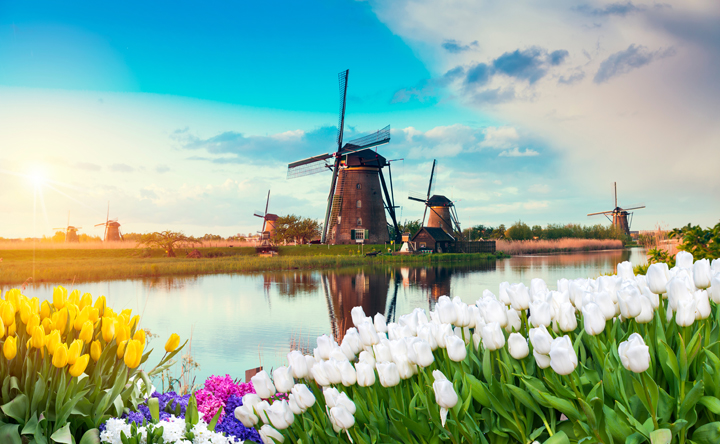
The tulip fields spread out like colourful carpets of blossom. These flowers, which originally come from Turkey, attract tourists from all over the world every year. Find out how tulips are traded on the stock exchange and why they have been so popular since the middle of the 16th century.
Holland is THE land of flowers par excellence.
For centuries, the Dutch have been growing tulips in the widest variety of colours and shapes. The conditions here are ideal for tulip growing: a long spring with cool nights and land enclosed by dykes, which ensures damp soil. The seemingly endless fields of colourful tulips delight the eye, but in fact it is not about what can be seen above ground. It is all about the bulb. In May, at the end of the tulip season, the blooms are cut off so that all the plant's strength goes into the tulip bulb. In summer the bulbs are dug up, cleaned, dried and finally offered for sale. Of course, tulips are also grown in Holland for the cut-flower trade. These are normally planted in large greenhouses, however, where they are protected from wind and weather.
How did tulips come to Holland?
The laleh (Turkish for tulip) grows wild in Turkey. The Ottoman sultans loved the tulip and had their palace gardens richly decorated with these flowers. The flower became a symbol of power and wealth, and Sultan Ahmed III gave tulip bulbs to important guests. An envoy of the Austrian Habsburgs at the court of Suleiman I was among the recipients. He sent a few bulbs to Carolus Clusius, court botanist to the Emperor of Austria. When Clusius became a professor in Leiden, he took the tulip bulbs with him to the Netherlands. He wanted to sell his exotic flowers, but he demanded too high a price. So one night some enterprising gentlemen sneaked into his garden and took the bulbs away. These stolen specimens are said to have formed the starting stock for tulip cultivation in Holland. The more the Golden Age developed in the Netherlands, the more the importance of the brightly coloured flowers grew. From paintings to tulip festivals – everything revolved around tulips. By the middle of the 17th century, tulips were so popular that the first speculative bubble arose, the «tulip mania». The greater the demand for the bulbs, the more expensive they became. They were traded as a currency until the market crashed.
Flowers as «currency»?
Today, 1.7 billion tulips a year are traded at the world's largest trading centre for flowers and plants. Royal FloraHolland is a cooperative association of 5,000 flower growers, mainly from the Netherlands, Belgium, France and Africa. What began in a pub in 1912 now takes place on over 715,000 m2. Every morning, Monday to Friday, the gates in Aalsmeer
open for a few hours and the world's largest flower auction begins. The flowers and plants to be auctioned are driven through the hall on trolleys for assessment. At the same time, the goods are promoted in the auction rooms. The roughly 1,500 buyers concentrate on the 10 large clocks and follow the prices nervously. The clock hands run backwards. The lot changes hands as soon as one of the buyers strikes by
pressing a button. As the logistical effort of this procedure reaches its limits, buyers have for some time been able to have the goods shown to them as a photo on screens (image auction) or even bid online from anywhere in the world. In Aalsmeer, around a third of the flowers are already traded digitally (and unseen).
It is not only in the morning that the trading building is a hive of activity. At night the freshly delivered flowers and plants are placed in the cold storage halls. Here they wait until the next day's auction. But there is no peace in the afternoon either, because then the flowers that have been bought are repacked and put together, and are then taken to the loading zones for the refrigerated lorries. From the outside it seems chaotic and unplanned, but the transport trolleys are fitted with labels. The staff scan these and are told via headphones which lorry gate the consignment must be taken to. This is how every flower reaches the right destination.
7 million flower bulbs
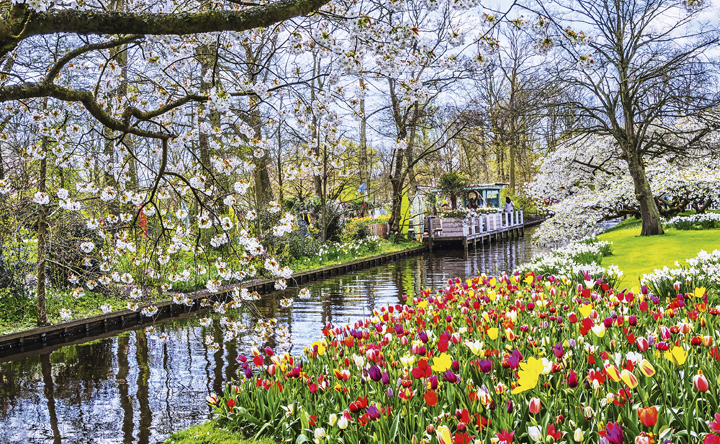
The 32-hectare park is open from mid-March to mid-May. During this time, around 800,000 visitors come from all over the world. The gardens and four pavilions show a fantastic collection of tulips, hyacinths, daffodils, orchids, roses, carnations, irises, lilies and many other flowers. The success story of the Keukenhof began with ten growers, flower exporters and the mayor of Lisse. The first exhibition was held in the historic park in 1950, and since then the Keukenhof has been devoted to a new theme every year and therefore always looks different.